
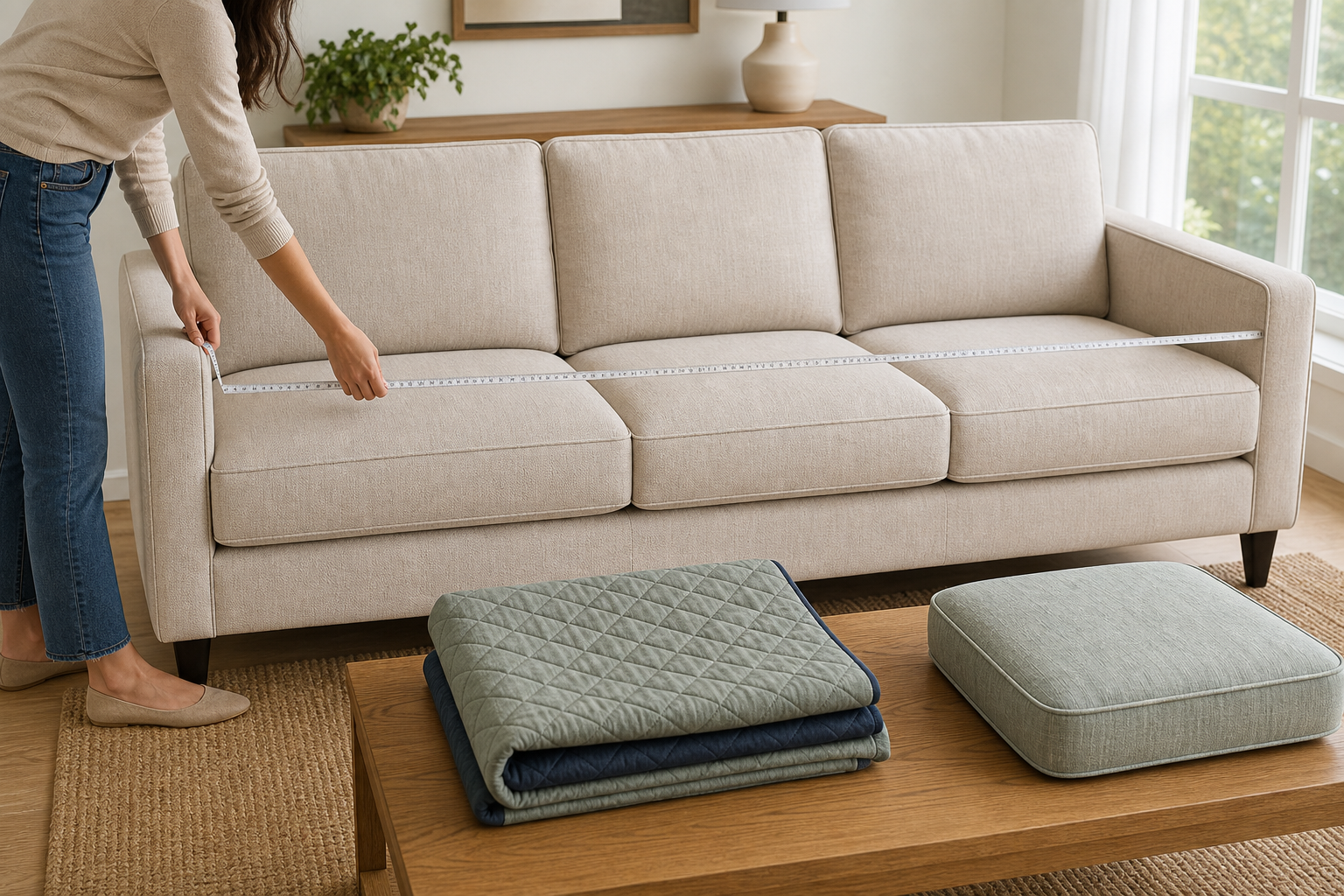
The short answer: measure the sofa's usable seat width, seat depth, back height, arm width and total outside width before choosing a cover. Compare those numbers with the live product page rather than buying by “two-seat” or “three-seat” labels alone. Choose a reversible or quilted indoor cover when the goal is an easy-to-remove protective layer on an existing sofa. Choose purpose-built outdoor seat-and-back cushions when you are filling a patio chair frame—not as a substitute for a fitted indoor slipcover.
Start with the actual furniture and a flexible tape. Comfy Sofa Cover's current catalog includes a Water Resistant Reversible Comfy Sofa Cover, Waterproof Quilted Sofa Covers, an Outdoor Cushion and Back Cushion Set, and a 2-Piece Outdoor Deep Seat Set with Foam Core and Removable Covers. Verify each listing's current dimensions, materials, care directions and included pieces before ordering.
Sofa-cover measurements at a glance
| Measure | Where to place the tape | Why it matters |
|---|---|---|
| Usable seat width | Inside edge of one arm to the other | Helps match the main sitting panel |
| Seat depth | Front edge of cushion to the base of the back | Reduces a cover that pulls short or bunches |
| Back height | Top of seat to top of back cushion | Checks how much vertical coverage is needed |
| Arm width and height | Across and up each arm at the widest points | Matters when the design includes arm panels |
| Total outside width | Farthest outside edge to outside edge | Useful for one-piece covers and room planning |
How to measure a sofa in six steps
- Sketch the sofa. Note whether it has separate cushions, attached backs, wide arms, a chaise, recliner sections or an unusual curve.
- Measure the seat width. Run the tape between the inner arm edges without following dips in soft upholstery.
- Measure seat depth. Start at the front of the sitting cushion and stop where it meets the back. Repeat on a chaise section.
- Measure the back and arms. Record the height from seat to back top, then each arm's width and height. Measure both sides if the sofa is asymmetrical.
- Record the total footprint. Measure outside width, overall depth and floor-to-top height. Doorways matter if adding thick cushions.
- Compare with the specific size chart. Write measurements in both inches and centimetres if the chart uses a different unit. Never infer size from the product photo.
Measure twice and record the larger result when upholstery compresses or curves. Keep the tape level and do not pull it tightly into padding. If a product provides a recommended measurement range, the furniture should sit inside that range; do not assume a cover will stretch unless the listing explicitly says so.
Reversible vs. quilted sofa covers
A reversible cover offers two usable faces, which can make a quick colour change practical. The reversible cover is described by the store as water resistant. That wording generally indicates resistance to limited moisture exposure, not indefinite protection from soaking, pooled liquid or pressure. Blot spills promptly and follow the product's care directions.
A quilted construction adds stitched layers and a more structured surface. The catalog's quilted cover uses “waterproof” in its product name; shoppers should still read the current specification for which layer or area the claim covers, how seams are constructed, and what use and care limits apply. No removable cover should be treated as permission to leave spills unattended or expose indoor furniture to outdoor weather.
When outdoor cushions are the better match
An outdoor lounge frame often needs both a seat cushion and a back cushion with dimensions matched to the frame. The outdoor seat-and-back set is a different product category from a draped sofa protector. Confirm seat width, depth, back height, cushion thickness, attachment method and the number of pieces included.
For deep seating, compare the two-piece foam-core set. “Outdoor” does not automatically mean it can remain uncovered through every storm, freeze or Toronto winter. Check the listing for the precise fabric and fill, and follow its storage and drying directions. Air out damp pieces fully before storage and keep them away from standing water unless the manufacturer explicitly directs otherwise.
Fit details that photos cannot settle
- Separate cushions: decide whether the cover goes over the entire seat or each cushion individually.
- Arm shape: rolled, square and sloped arms use fabric differently; compare the measurement diagram, not just the silhouette.
- Recliners: confirm that a cover is designed for moving sections and will not interfere with controls or mechanisms.
- Non-slip features: inspect the listing for straps, tucks or backing. Reposition any cover that shifts into walkways or moving parts.
- Pets and children: a cover can simplify routine cleanup, but it is not a safety barrier. Keep loose ties and damaged fasteners secured.
Care: follow the product, not a universal recipe
Before laundering, check the sewn-in label and current product instructions. The U.S. Federal Trade Commission's care-label guidance emphasizes that care directions should clearly describe regular care and have a reasonable basis. Although its Care Labeling Rule primarily covers apparel and certain piece goods, the practical consumer lesson applies here: do not guess washing temperature, bleach use, drying heat or ironing from appearance.
The American Cleaning Institute recommends following detergent directions and fabric-care labels and treating spills before they dry. First remove crumbs or loose debris using a method allowed by the product instructions. Blot rather than scrub a fresh spill, test any cleaner in an inconspicuous area, and avoid saturating foam or upholstery. Wash removable pieces only as directed; closures, coatings, filling and quilting can require different care. Dry completely before reinstalling or storing.
A pre-order checklist
- Save width, depth, back height, arm and total measurements.
- Confirm whether dimensions describe furniture or the flat cover.
- Check every included piece, colour, fabric and attachment detail.
- Read the exact water-resistance or waterproof specification and limitations.
- Review care directions and whether the cover is removable.
- Check the current delivery and return policy before ordering.
Frequently asked questions
Should I size up if my sofa is between measurements?
Use the range and instructions on the specific product page. A larger cover may create excess fabric, while a smaller one may not reach or stay positioned. Contact the store with your recorded measurements when the chart does not settle the choice.
Is water resistant the same as waterproof?
No. Water resistance normally describes limited resistance to moisture; waterproof is a stronger claim but still needs context about tested material, seams, duration and care. Read the exact listing and do not extend either claim beyond what it states.
Can an indoor sofa cover be used outdoors?
Only if the product page expressly supports that use. Indoor covers may not be designed for UV exposure, rain, temperature swings or prolonged dampness. Purpose-built outdoor cushions are the clearer category for patio frames.
How do I measure an L-shaped sectional?
Sketch every module and measure each seat section, chaise and corner separately, plus overall outside dimensions. Confirm that the chosen product is specifically compatible with modular or sectional layouts.
How often should a sofa cover be washed?
There is no universal schedule. Use the care label, household use, spills, pets and visible soil as guides. Routine vacuuming or gentle debris removal may reduce unnecessary laundering when allowed.
Bottom line
Good fit starts with five real measurements, not a seat-count nickname. Use a reversible or quilted cover to protect an existing indoor sofa when its size and construction match. Choose separately sized outdoor cushions for patio frames. Above all, distinguish water resistance from waterproofing, verify the live specifications and follow the product's own care directions.